How to Make a Blog Schedule
 Making posts offers a wealth of great benefits and opportunities for your website and business. However, writing regular blog posts might seem like an uphill battle, particularly if you don’t like writing and find yourself staring at a blank screen. Sometimes, just coming up with ideas for what to write about can put you off the entire process altogether. In this article, we discuss how to make a blog schedule, what to write about and how to approach the process differently.
Why should you make regular blog posts?
Search Engine Optimisation (SEO) There’s no getting away from it – A website isn’t just a brochure. You shouldn’t just create it and walk away. Digital marketing and the competition for web ranking has evolved. If a website is to get any traction, it must be relevant. Google bases a website’s status and relevance on how often it changes, so it’s important to keep its content fresh, engaging, and relevant. One way to do that is to release a regular blog, whether daily, weekly or monthly.
Stamp your authority – Blogs provide an excellent opportunity to establish your brand as an authority in your field. It also provides a great platform to share valuable insights, tips, and industry news or even shine a spotlight on your products or services.
The blog has a long tail – Blogs are accumulative. Anything you publish continues to generate traffic long after it has been uploaded. Over time, older posts can accumulate backlinks, gain authority, and rank higher in search engine results, driving consistent organic traffic. This longevity allows blogs to target niche keywords and topics that may not bring immediate results but gradually attract a steady stream of specifically interested visitors.
Establish a fan base – Publishing content on a regular basis attracts followers. They will likely remain loyal and keep returning for more if they know they can expect regular, consistent content. From a brand perspective, it gives you an audience and many potential business opportunities.
Recycling blogs – A well-conceived blog can be used many times and recycled in many different formats. Your blog could be made into a video, or parts could appear in your next company newsletter. Perhaps you could use it as a featured article in a local magazine or use elements of it in a speech. You could even revisit a subject later and see if anything has changed. Whatever you choose to use the blog for, a well-thought-out piece of work is never wasted.
 Why do you need a blog Schedule?
As I mentioned, it’s easy to find yourself staring at a blank screen, not knowing where to start. Sometimes, a title or a question is all you need to set the ball rolling and create focus.
Creating a schedule gives you a place to start and helps you maintain a steady output of high-quality content. If you know in advance what to write and when it is due, you can avoid the procrastination and last-minute scramble to pluck a title out of thin air, often resulting in low-quality work.
With a schedule, you can organise your marketing plan with a clear direction. Planning your blogs will allow you to explore various content types, from how-to guides to interviews, opinion pieces, and product demonstration videos. It will also allow you to cover a broad range of subjects to balance short-term trends with evergreen content, creating a more engaging and diverse blog.
How to make a blog schedule
Creating a blog schedule is easy; it just takes a few simple steps and a bit of thought and imagination. It helps to have a spreadsheet, but a pen and paper will serve just as well.
1. Release Dates
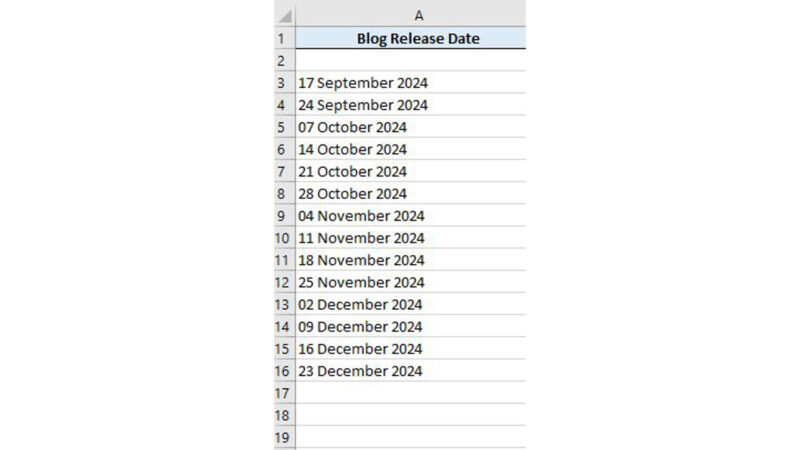
Create a list of blog release dates in column ‘A’ for the next year. These can repeat daily, weekly, monthly or whatever regularity you want your blog posts to release. Having the dates in place will help keep you motivated and focused.
2. Create Categories
Create subject categories for your blogs. Here are some examples that you might choose if you were in the following industries:
Home Appliance Retailer:
- Washing Machines,
- Tumble Dryers,
- Dishwashers,
- Refrigerators,
- Cookers,
- Microwaves.
Garage:
- MOTs,
- Servicing,
- Repairs,
- Tyres,
- Windscreens,
- Bodywork.
Solicitors:
- Commercial Property,
- Employment Law,
- Family & Relationships,
- Litigation,
- Personal Injury,
- Probate.
Garden Landscapers:
- Lawns,
- Trees & Shrubs,
- Garden Design,
- Plants & Flowers,
- Hard Landscaping,
- Pruning.
Aim to list 6-12 categories relevant to your company that will interest your customers.
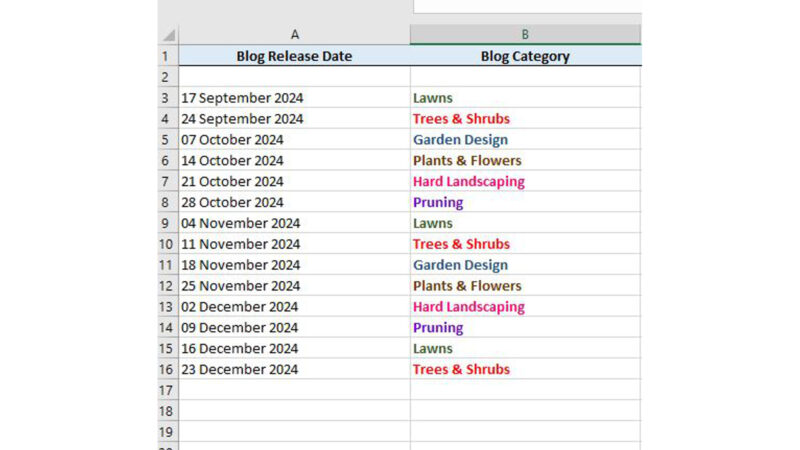
List all of the categories in column ‘B’. It would be useful to assign each category with a different colour. Copy and repeat the list until a category is listed next to each date.

3. Create Subjects
There’s a famous Rudyard Kipling quote:
“I keep six honest serving men, They taught me all I knew; Their names are What and Why and When, And How and Where and Who..”
These six fundamental questions are the pillars of effective communication, inquiry, and storytelling. They can also be very useful as a starting point for blog post titles.
Here are a few simple examples of possible blog posts using the Kipling method and combining some interesting titles with the categories we suggested for landscape gardening earlier in the post:
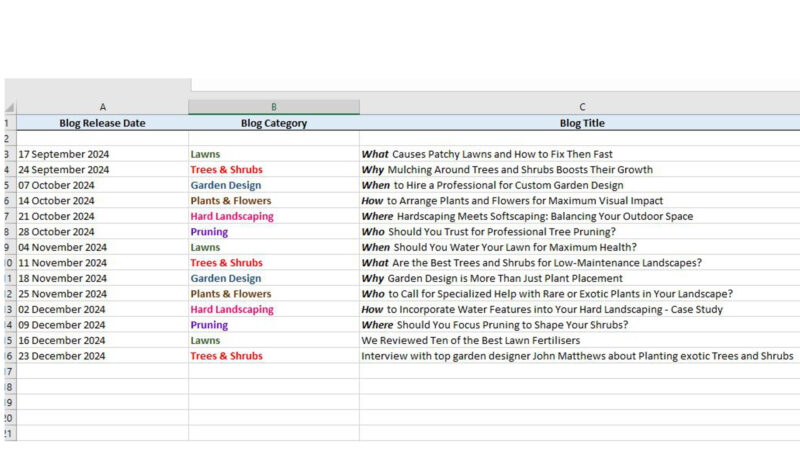
(Lawns) What Causes Patchy Lawns and How to Fix Them Fast
(Trees & Shrubs) Why Mulching Around Trees and Shrubs Boosts Their Growth
(Garden Design) When to Hire a Professional for Custom Garden Design
(Plants & Flowers) How to Arrange Plants and Flowers for Maximum Visual Impact
(Hard Landscaping) Where Hardscaping Meets Softscaping: Balancing Your Outdoor Space
(Pruning) Who Should You Trust for Professional Tree Pruning?
Create a column ‘C’ in your spreadsheet entitled ‘Blog Title.’ See if you can develop some interesting blog subjects using the Kipling prefixes and basing the blog on the category in column B. Now, jumble the prefixes around and see what other interesting titles come to mind.
Other Blog Types
There are many different approaches to writing a blog and other ways to generate content. Here are some more ideas that you may not have thought of:
Case Studies: They are a great way to advertise the great work you’ve done for previous clients, give future clients insight into how your company works and establish yourself as an expert within your field.
Ask The Expert: This is another way to establish yourself as an expert and a useful way to get more traffic from people looking for solutions to their problems or answers to their questions.
Frequently Asked Questions List: Answers to common questions from customers are a great way to boost your customer service and avoid repeatedly answering the same questions.
Checklists: Another useful article might be ‘Top ten things to prepare your garden for winter.’
Top Ten Lists: Lists are a great way to build content fast. A good example would be ‘Top ten perennials for a small garden.’
Quiz: Build a fun, relevant quiz to test your customer knowledge.
Interviews: Find an interesting expert or member of the team to interview.
Product Review: Reviews generate content and advertise a product simultaneously.
Blog Formats
There are no hard and fast rules regarding what form these posts should take. Podcasts, videos, downloads, manuals, templates, authentic image galleries and case studies are just some examples of less traditional types of blogs that you could produce besides the written article. The more diverse the format is, the more likely it is to keep your audience interested.
Rich Content Blog
Another approach is the Rich Content blog. This kind of blog is a feature article containing many different formats; for example, you might do a case study about garden features, which could contain:
- Text about previous work fitting a water feature for a client
- Image gallery of the water feature
- A video showing how to fit a water feature
- A product review of water features
Conclusion
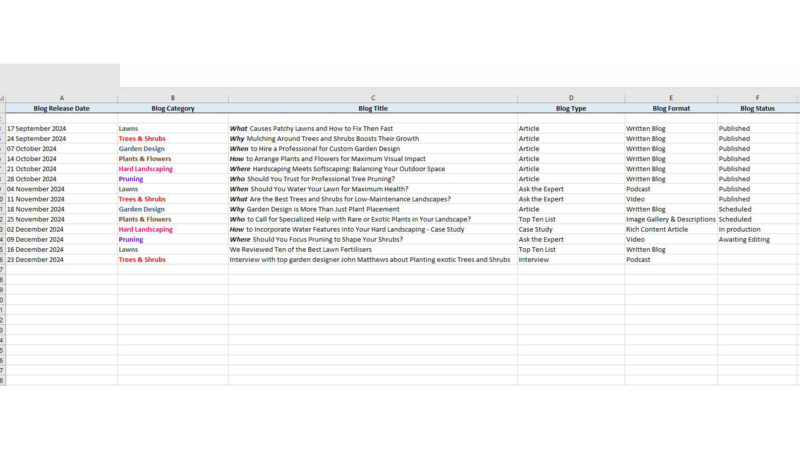
As your blog schedule develops, you might want to add columns such as Blog Type and Blog Format. Another useful column would be Blog Status, which lists the stage of blog development.
A word of caution. Always keep the content relevant to your product or service and suitable for your customer base. Customers for a firm of solicitors might lose confidence in the company if they started producing comedy video shorts for their blog.
Summary
Heres a summary of how to create a blog schedule:
- Plan and list your blog release dates for the next year
- Create 6-12 categories that align with your business. Assign colours for clarity
- Create titles based on prefixes what, why, when, how, where and who
- Explore other blog types, such as case studies, FAQs and interviews for variety
- Blog formats are another great way to mix things up a bit; try videos, podcasts and downloads as an alternative
- Write a rich content blog once in a while for an in-depth article
Further Reading
The Anatomy of a Perfect Blog Post
Need help turning this advice into action?
If you are reviewing your website, marketing or online visibility, we can help you work out what to improve first.
Related articles
 Content
How to Explain Complicated Services Simply
If it takes ten minutes to explain what your business does, you may have already lost the customer. Just because you know your profession…
Read article
Content
How to Explain Complicated Services Simply
If it takes ten minutes to explain what your business does, you may have already lost the customer. Just because you know your profession…
Read article
 SEO
Why Sounding Human Again May Be the Future of SEO
Why sounding human again may be the future of SEO. Discover why authentic content, Geo Marketing, and real expertise matter more than ever in…
Read article
SEO
Why Sounding Human Again May Be the Future of SEO
Why sounding human again may be the future of SEO. Discover why authentic content, Geo Marketing, and real expertise matter more than ever in…
Read article
 Content
Why the Same Message Needs to Be Told in Different Ways
There is a quiet myth in business that repeating yourself looks unprofessional. We explore why the same message needs to be told in different…
Read article
Content
Why the Same Message Needs to Be Told in Different Ways
There is a quiet myth in business that repeating yourself looks unprofessional. We explore why the same message needs to be told in different…
Read article
 VideoandWeb.com