How to Explain Complicated Services Simply

Complicated services don’t need complicated explanations. Start with what your customer actually needs to know.
If it takes ten minutes to explain what your business does, you may have already lost the customer. Just because you know your profession inside out, it doesn’t mean your customer does. Your website gives you the perfect opportunity to set out your stall and explain what you offer in a way people can understand. You’d be surprised how many businesses get it wrong.
Some businesses have an easy marketing job. A window cleaner cleans windows. A florist sells flowers. A restaurant serves food. Most potential customers understand the basic proposition before the business says a word.
Other businesses have a much harder task. Consultants, accountants, engineers, software companies, specialist manufacturers and professional practices can offer services that genuinely need some explaining. Even an apparently straightforward business may have specialist services, technical processes or regulatory requirements that customers rarely encounter until they suddenly need them. The problem is that expertise can sometimes make those services harder to explain. You know how much knowledge sits behind what you do. You understand the terminology, the process, the technology and all the variables that affect the job. Naturally, you want prospective customers to appreciate that expertise, so you start explaining it. Before long, a perfectly good service page starts to look more like a technical document than a useful and informative web page. Meanwhile, the customer may still be trying to answer a much simpler question:

Complicated services don’t need complicated explanations. Start with what your customer actually needs to know.
Can you help me with my problem?
That is usually where the explanation should begin. Start where the customer starts. Businesses naturally tend to describe their services from the inside out. We know what we do, so we begin with the name of the service and explain its features, processes and capabilities. Customers often approach the same subject from the opposite direction. They have a problem, an ambition or a question, and they want to know whether you can help.
Imagine a company that provides sophisticated business software. Its website could begin by explaining the platform architecture, integrations and clever technology behind the system. All of that may matter eventually, but perhaps the customer arrived because three staff members spend every Friday afternoon manually assembling the same report. Start there.
“Your team currently spends hours pulling information together from different systems. We bring it into one place and produce the report automatically.”
Suddenly, the service makes sense. The customer understands why it matters before they need to understand how it works. You haven’t dumbed anything down. You have simply put the information in the right order.
Simple doesn’t mean simplistic
There is a balance to strike. Your website shouldn’t read as though a 12-year-old wrote it if you sell a highly technical professional service. You need to understand your market and speak at an appropriate level. But there is a considerable distance between writing for an intelligent audience and making every other word something they need a dictionary to decipher. Clarity doesn’t diminish expertise. In many cases, it demonstrates it.
A surgeon can explain an operation to a patient without giving them a medical degree. An accountant can explain the implications of a tax decision without starting with the legislation. An engineer can explain why a component keeps failing without taking the customer through every calculation that led to the diagnosis.
Someone who understands a subject thoroughly should be able to identify which information matters to the person standing in front of them. Specialist terminology still has its place. Sometimes a technical term gives you the most precise way to describe something, particularly when your audience already understands the subject. Problems arise when businesses use industry language without considering whether their customers speak it too. The same goes for the sheer quantity of information. Your customer may genuinely need access to a detailed technical specification, legal document or compliance information, but that doesn’t mean you need to reproduce every word in the middle of the main service page. Give them the important points. Highlight what they need to know. Then, where appropriate, provide the full technical or legal information as a downloadable document or a separate page. You aren’t hiding information. You’re making it easier to use.

Knowing your subject is one thing. Being able to explain it clearly to somebody else is another.
Give people a reason to care about the complicated bit
Businesses can become rather attached to features. A manufacturer may feel immensely proud of a particular production process. A software developer may want to talk about an API integration. At Video & Web, we can get excited about a clever piece of technology we’ve built into a website. Customers rarely buy the clever bit simply because it is clever. They buy what it does for them.
So rather than beginning with: “Our system uses an automated API integration…”. You might say: “Your orders pass straight into the system, so your team doesn’t have to enter them twice.” Now the customer has a reason to care about the API. If they want to know how you achieve that result, you can explain the technology next. The technical information still matters. The difference is that you have given it context.

Give people something familiar to hold on to
When the subject itself is unfamiliar, comparisons can provide a useful shortcut. Cloud storage becomes easier to understand if we describe it as a filing cabinet that you can reach from anywhere. Website hosting can be the plot of land where your website lives. Two-factor authentication makes more immediate sense if we compare it with needing both a key and a code to open a door.

A familiar comparison can give people a quick way into an unfamiliar idea.
No analogy explains every detail, and it shouldn’t. Its job is to give somebody a mental foothold. Once they grasp the basic idea, you can introduce more detail. This principle can shape the whole page. Start with the information most people need, then let them explore further according to their level of interest. Someone looking for reassurance may only read the first few sections. A prospective customer comparing suppliers might read every word. A technically minded buyer may head straight for specifications and supporting documentation.
We are fond of saying that your website is like a department store. The footprint is your little corner of the web, but every useful piece of information you add gives you another floor, department or display for people to explore. You wouldn’t expect every customer entering a department store to visit every floor, and your website should work in much the same way. Someone may only need the straightforward explanation on your main service page. Another visitor may want case studies, technical information, videos, FAQs, or detailed specifications before they decide. The trick isn’t to squeeze the whole department store into the window display. Give people enough at the entrance to understand what you offer, then make it easy for them to explore the departments that matter to them.

Don’t try to squeeze the whole department store into the window display. Show enough to draw people in, then let them explore.
Sometimes it is easier to show than explain.
Words aren’t always the best way to communicate a complicated idea. If you manufacture something unusual, show it working. If your service involves a process, demonstrate it. If your software removes ten tedious steps from someone’s workday, let people see those steps disappear. Video works particularly well because people can hear an explanation while watching the thing you are talking about. Animation can reveal processes a camera cannot capture, while a well-designed diagram can make a relationship obvious far faster than several paragraphs of copy.
You don’t have to cram everything into one enormous video either. Different customers want different information. A handful of short videos, each answering a particular question or demonstrating one part of a product or service, can prove far more useful than a 20-minute epic that tries to cover everything.
The same discipline applies to diagrams and graphics. A flowchart containing 27 arrows, 14 boxes and six colours may accurately represent your internal process, but it probably won’t help somebody who has only just discovered your business.
Choose the format that makes the idea easier to understand, rather than using it to demonstrate how complicated the idea is.
Remember what it was like not to know.
Perhaps the hardest part of explaining a specialist service is remembering what it felt like before you became an expert. After 10, 20 or 30 years in an industry, certain ideas become obvious. Acronyms turn into everyday language. Processes that once required thought become second nature. You stop noticing how much knowledge somebody needs before your explanation makes sense. Your customers haven’t necessarily travelled that road with you. That makes somebody outside your industry surprisingly useful when you test your website. Give them a service page and ask what they think you do.
Don’t ask, “Does this make sense?” People are polite. Most will probably say yes.
Instead, ask them to explain the service back to you in their own words. What do they think you offer? Who do they think it’s for? What problem does it solve? If their explanation bears little resemblance to what you thought you had written, you have discovered something valuable.
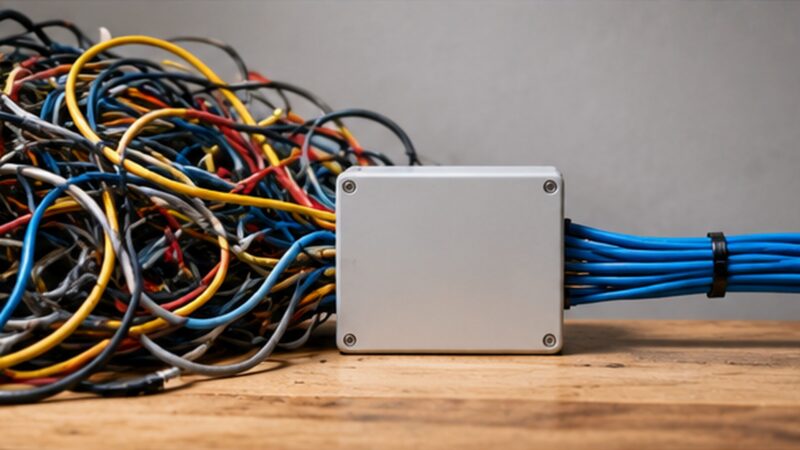
Your customer doesn’t necessarily need to understand all the complexity behind the service. They need to understand what comes out the other side.
Make the complicated part your problem.
Customers don’t need to become experts in your business before they can buy from you. They need enough understanding to recognise their problem, see how you can help and feel comfortable taking the next step. Your expertise hasn’t disappeared simply because you explain it clearly. The technology, specialist knowledge, technical processes, regulations and years of experience still sit behind the service. In fact, dealing with all that complexity may be precisely what the customer wants to pay you for.
A useful irony: the more complicated your service is, the more valuable a simple explanation becomes. If somebody reaches the end of your page and thinks, “Ah, now I understand,” you haven’t made your expertise look smaller. You’ve made it useful.
Need help turning this advice into action?
If you are reviewing your website, marketing or online visibility, we can help you work out what to improve first.
Related articles
 SEO
Why Sounding Human Again May Be the Future of SEO
Why sounding human again may be the future of SEO. Discover why authentic content, Geo Marketing, and real expertise matter more than ever in…
Read article
SEO
Why Sounding Human Again May Be the Future of SEO
Why sounding human again may be the future of SEO. Discover why authentic content, Geo Marketing, and real expertise matter more than ever in…
Read article
 Content
Why the Same Message Needs to Be Told in Different Ways
There is a quiet myth in business that repeating yourself looks unprofessional. We explore why the same message needs to be told in different…
Read article
Content
Why the Same Message Needs to Be Told in Different Ways
There is a quiet myth in business that repeating yourself looks unprofessional. We explore why the same message needs to be told in different…
Read article
 SEO
How to Get Your Website to the Front of the Crowd
Creating a website today without SEO, social media, or any marketing at all is a bit like standing at the back of the O2…
Read article
SEO
How to Get Your Website to the Front of the Crowd
Creating a website today without SEO, social media, or any marketing at all is a bit like standing at the back of the O2…
Read article
 VideoandWeb.com