The Best Email Marketing Platforms For Small Businesses
 The Best Email Marketing Platforms For Small Businesses. Welcome to our blog post on the most powerful and affordable email marketing platforms specifically designed for small businesses! Effective communication with your customers has become more crucial in today’s digitally-driven world. And what better way to engage and connect with your audience than through targeted email campaigns?
Finding the perfect email marketing platform can be overwhelming, especially on a tight budget. But worry not! We’ve researched you and compiled a list of top-notch platforms to help skyrocket your business without breaking the bank.
Introduction to Email Marketing Platforms
Email marketing platforms allow small businesses to reach a large audience at a fraction of the cost of traditional marketing methods. These platforms offer a variety of features, such as email templates, list management tools, and tracking and reporting capabilities, that make it easy to create and send newsletters, announcements, and other types of email campaigns.
When choosing an email marketing platform, consider your needs and budget. Some platforms are free, while others charge a monthly fee. There are also several options available that cater to specific industries or business types.
Types of Email Marketing Platforms
Many different types of email marketing platforms are available on the market today. Some are more comprehensive than others, but all offer a way to reach your target audience through email. Here are some of the most popular types of email marketing platforms:
1. Constant Contact
Constant Contact is one of the most popular email marketing platforms today. It offers many features to help small businesses create professional-looking emails, including templates, branding, and reporting tools. Constant Contact also offers excellent customer support and a free 60-day trial.
2. MailChimp
MailChimp is another popular email marketing platform that’s perfect for small businesses. It offers a user-friendly interface, customizable templates, and powerful automation features. Plus, MailChimp integrates with several other software programs (like Shopify), making adding email marketing into your existing workflows easy. MailChimp also offers a free plan for small businesses.
3. AWeber
AWeber is suited to small businesses looking for an affordable email marketing platform. It offers all the features needed to create professional emails, including templates, autoresponders, and reporting.
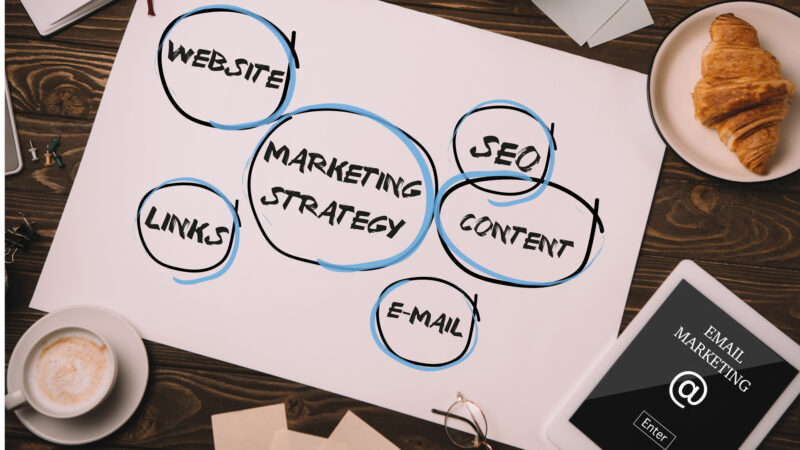
top view of paper with marketing strategy, digital tablet, business supplies, croissant and coffee
How to Choose the Right Platform
There are several things to consider when choosing the right email marketing platform for your small business. The first is to consider your budget. Many free and paid options are available, so you’ll need to decide how much you’re willing to spend.

Next, think about your needs. What features do you need in an email marketing platform? Do you need something simple, or do you need more advanced features? Make a list of what’s important to you and use that to guide your decision.
Take some time to research your options. Read reviews, compare pricing, and look at feature lists to find your small business’s best email marketing platform.
How to Get Started With Email Marketing
Assuming you have a small business and an email list of subscribers, here are a few tips on how to get started with email marketing:
1. Keep it personal – your subscribers are likelier to engage with an email that feels like it’s coming from a friend rather than a faceless brand. Be sure to use a friendly from name, and avoid coming across as too sales-y or promotional.
2. Make it valuable – your subscribers won’t want to open emails that don’t offer them something valuable, whether helpful information, coupon codes, or early access to new products or sales. Consider what would make YOU want to open an email, and aim to provide that for your subscribers.
3. Be consistent – send emails regularly, but not so often that they become annoying. Once or twice a week is usually a good frequency for most small businesses. And be sure to keep your branding consistent in each email, using the same colours, logos, and overall design aesthetic. This will help your emails feel like they’re part of a cohesive whole, not just random messages sporadically.
4. Define Your Goal – before using email marketing, step back and define your goal. What do you want to achieve with your email marketing campaign? Are you looking to boost sales, increase brand awareness, or drive traffic to your website? Once you know your goal, you can choose the right platform and strategies to help you achieve it.
5. Segment Your List – segment your list to send more targeted emails. For example, if you have a list of customers who have purchased in the past 30 days, you could email them a coupon code for their next purchase. Or if you have a list of subscribers who haven’t opened an email in 6 months, you could send them a “re-engagement” email asking them if they’re still interested in receiving emails from you. Segmenting your list helps ensure that your recipients are getting emails that are relevant to them, which can lead to higher engagement rates.
Conclusion
Email marketing is a powerful and affordable way to reach potential customers and generate leads. We hope this article has given you some insight into the best email marketing platforms tailored for small businesses so that you can find one that meets your needs. As long as you are willing to invest time, energy, and money into creating high-quality emails that stand out from the competition, there is no doubt that an effective email marketing strategy can be an invaluable asset for your business.
Further Reading
The Importance of Building an Email Marketing List for Small Businesses
Need help turning this advice into action?
If you are reviewing your website, marketing or online visibility, we can help you work out what to improve first.
Related articles
 Content
How to Explain Complicated Services Simply
If it takes ten minutes to explain what your business does, you may have already lost the customer. Just because you know your profession…
Read article
Content
How to Explain Complicated Services Simply
If it takes ten minutes to explain what your business does, you may have already lost the customer. Just because you know your profession…
Read article
 Content
Why the Same Message Needs to Be Told in Different Ways
There is a quiet myth in business that repeating yourself looks unprofessional. We explore why the same message needs to be told in different…
Read article
Content
Why the Same Message Needs to Be Told in Different Ways
There is a quiet myth in business that repeating yourself looks unprofessional. We explore why the same message needs to be told in different…
Read article
 SEO
How to Get Your Website to the Front of the Crowd
Creating a website today without SEO, social media, or any marketing at all is a bit like standing at the back of the O2…
Read article
SEO
How to Get Your Website to the Front of the Crowd
Creating a website today without SEO, social media, or any marketing at all is a bit like standing at the back of the O2…
Read article
 VideoandWeb.com