Your Website Is Never Finished: Why it Needs to Grow With Your Business
 A website should not be treated as an online brochure that you build, publish and then leave alone. It is an active business asset: one that should develop as your company, your customers and the digital world around you change.
That does not mean endlessly redesigning it, publishing for the sake of appearing active, or finding new jobs to do simply because the website exists.
It means recognising that a website has to live in the real world.
Businesses change. Services evolve. Customers ask different questions. Technology moves on. Search behaviour shifts. Competitors improve their own digital presence. What felt accurate and useful when a website launched may look rather different two or three years later.
That is why a good website is never really finished. In many ways, it is organic. You establish the foundations, but what happens afterwards depends on how carefully you cultivate what you have created.
Going live is the beginning, not the end
Launching a new website often feels like the end of a substantial project. Months of decisions about design, structure, imagery, wording and functionality finally come together, and there is an understandable sense of completion when the site goes live.
But that is also the point at which something more useful begins to happen: real people start using it.
Until then, much of the work is based on informed judgement. Once visitors arrive, the website begins to produce evidence. Certain pages attract more attention than expected. Some services generate enquiries while others do not. Customers repeatedly ask questions that the website was supposed to answer. A page that looked perfectly clear during development turns out to be less obvious to somebody encountering the business for the first time.
This is valuable information. A website should be allowed to respond to it.
The most effective websites tend to become better over time because they are adjusted in response to real behaviour, changing priorities and a deeper understanding of what customers need. The alternative is a site frozen at the moment it was launched, gradually becoming less representative of the business behind it.
Your business will not stand still
Very few businesses remain unchanged for long. A company may introduce a new service, stop offering another, recruit a specialist, change the way it works, enter a new market or discover that a particular area of expertise has become much more important than anyone expected.
Yet websites often lag behind. The result can be a peculiar disconnect in which the real business has moved forward while the website continues describing an earlier version of it.
Sometimes this is obvious: an old team photograph, a discontinued service or a page that refers to technology nobody uses any more. More often, the problem is subtler. The website may still be factually correct, but the emphasis is wrong. The service that now drives the business is buried in the navigation, while something that mattered five years ago still dominates the homepage.
Keeping a website current is therefore not simply about adding new material. Often it is about refining the emphasis and making sure the digital version of the business still resembles the real one.
That process can involve relatively small changes. A service page may need expanding because the company has developed considerably more expertise in that area. A case study may demonstrate something that was previously only claimed in sales copy. An old page may need simplifying because experience has shown that customers respond better to a clearer explanation.
These are not redesigns for the sake of redesigning. They are the normal process of keeping an important business asset useful.
A website should feel like the company behind it
A website is often one of the first meaningful encounters someone has with a business. That makes appearance important, but appearance is only part of the job. A good website should also give a sense of the organisation behind it. The language, photography, video, layout and even the way information is organised all contribute to the impression a visitor forms.
There is no universal formula for this.
A technical consultancy may need to communicate depth and authority. A creative business may benefit from showing more personality. A professional practice may need to make complex information feel reassuring and understandable. A small company may be at its strongest when it shows the actual people, experience and premises behind the service rather than trying to imitate a much larger organisation.
The objective is not to make every business look the same kind of “professional”. It is to communicate the right character with clarity and consistency. This is where the old idea of a website as an online brochure begins to break down.
A brochure describes a company, a website can do considerably more. It can allow people to explore, compare, watch, read, verify, enquire and gradually decide whether this is a business they trust.

It is still a shop window, but a much more useful one
The traditional comparison between a website and a shop window remains useful because first impressions still matter.
A visitor who encounters outdated information, confusing navigation, poor mobile usability or a page that never quite answers the question they came with may simply leave. Online, the next option is rarely more than a click away. A website has one enormous advantage over a physical shop window: it can continue improving.
You can make important information easier to find. You can answer questions before a customer asks them. You can show previous work rather than merely claim experience. You can use video when seeing something is more useful than reading about it. You can make clearer routes for different customers and remove unnecessary obstacles between interest and enquiry.
Over time, the website can become more useful precisely because you know more about the people using it. That is why continual improvement matters far more than simply keeping the design looking fashionable.
Your website does not exist in isolation
A modern website also needs to be understood as part of a much wider digital presence. Somebody might first encounter a business through a Google search. Another person may arrive after seeing a video, a social media post, an email, an online directory or a recommendation from someone they trust.

Those journeys may begin in different places, but the website is often where people come to investigate further. That makes it an important point of connection.
A genuinely useful article can support search visibility and give you something worthwhile to share through social media. A common customer question might begin as a conversation, become a website article and later provide the basis for a short video. A case study can help with search, sales conversations and credibility at the same time.
The best digital activity rarely exists in separate boxes labelled “website”, “SEO”, “video” and “social media”. Each part should strengthen the others. Your website may sit at the centre of that activity, but it should never become an island.
Content should make the website more useful
One of the most obvious ways to develop a website is through content, but this is also where businesses can easily become distracted.
For years, companies were encouraged to keep publishing because “Google likes fresh content”. That idea led to an enormous amount of forgettable material being created simply because another blog post was due. A website does not become better merely because it becomes larger.
The useful question is not, “What can we publish this week?”. It is, “What would genuinely help the people we want to reach?”
That might mean explaining something customers repeatedly misunderstand, comparing two services, answering an awkward question openly, showing how a project was approached or sharing expertise that normally only emerges during a conversation with the team. Good content makes a website deeper rather than merely bigger.
Over time, it can turn a relatively simple site into a valuable resource: one that demonstrates experience, answers questions and helps prospective customers understand the business before they ever make contact. Sometimes that means publishing something new. At other times, the better decision is to improve an existing page.
An article written several years ago may still cover an important subject but contain outdated examples. Two weak pages may be more useful combined into one authoritative guide. A popular page may need a clearer next step. A service page may deserve more detail because it has become central to the company.
Website development does not always mean creating more. Quite often, it means making what is already there better.

SEO should support the website, not distort it
Search engine optimisation belongs within this process, but it should not dominate it.
The strongest SEO tends to emerge when a website is technically sound, clearly structured and genuinely useful to the people it is trying to reach. Search engines need to understand the subject of a page, but human visitors need to understand it too.
That means the technical and editorial parts of a website need to work together. Pages should have a clear purpose. Information should be organised logically. Internal links should help people discover related subjects. The website should work properly on different devices and perform reliably. Content should address topics that matter to potential customers rather than simply chasing phrases that happen to have search volume.
Keywords still have a role, but good SEO is not the art of repeating them often enough. It is about understanding what people are looking for, creating the most useful response you can, and making sure search engines can find and interpret it.
The goal is not simply more traffic. A thousand visitors who have no interest in what you offer are of considerably less value than a smaller number of people who arrived because your website answered exactly the question they were asking.
Some of the most important work is invisible
Not every improvement to a website produces a new page or a visible design change. Websites depend on technology, and technology does not stand still.
Content management systems are updated. Plugins change. Browsers develop. Devices change. Forms stop working. Links break. Pages become slower as more material is added. Security requirements evolve. These things are less exciting than a redesign, but they matter.
A beautiful website with a broken enquiry form is not doing its job. Nor is a site that looks impressive on a desktop but is awkward to use on a phone. Maintenance is therefore part of the same wider idea. If a website is an active business asset, it deserves to be looked after like one.
The answer is not constant activity. It is direction.
Treating a website as something that evolves does not mean constantly changing it. In fact, random activity can be just as unhelpful as neglect. The important question is always what the website is supposed to achieve.
Perhaps the business needs more enquiries for a particular service. Perhaps customers do not understand an important part of the offer. Maybe the company has developed expertise that is barely visible online. Perhaps the website receives plenty of visitors but too few of them take the next step.
Once the problem is clear, the work becomes much easier to prioritise. You can improve the relevant page, develop the right content, strengthen the calls to action, create supporting video, review the search opportunity or simplify the customer journey.
Then you can see what happens. That is a far healthier way to develop a website than continually adding things because somebody once said a website needs to be “kept fresh”. A useful cycle is simply to plan, create, observe and improve. Then repeat when there is a reason to.

A website needs cultivating
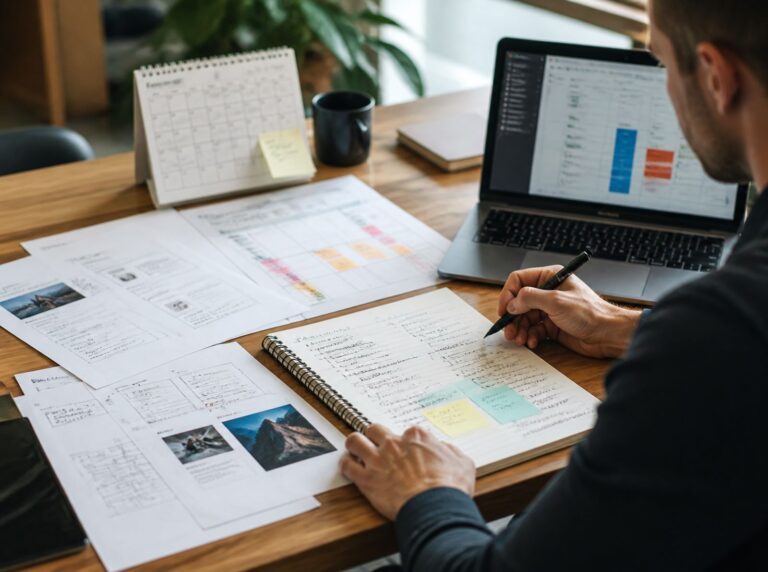
Perhaps this is the best way to think about a website. Not as a brochure. Not even as a finished product. But as something you cultivate. You establish strong foundations, give it direction and allow it to develop. You pay attention to the parts that are working, improve the areas that are not and remove things that no longer serve a purpose.
Sometimes growth comes from adding something new. Sometimes it comes from pruning what is already there. The important thing is that the website remains connected to the business it represents. Because a good website should not simply preserve a snapshot of what your company looked like on the day it launched.
It should continue to represent the business you are building now.
Need help turning this advice into action?
If you are reviewing your website, marketing or online visibility, we can help you work out what to improve first.
Related articles
 Marketing Strategy
First you need a strategy – and then you need to review it
Good digital marketing starts with knowing what you are trying to achieve. Without that, it is very easy to spend time and money on…
Read article
Marketing Strategy
First you need a strategy – and then you need to review it
Good digital marketing starts with knowing what you are trying to achieve. Without that, it is very easy to spend time and money on…
Read article
 Marketing Strategy
What Emotion Are You Selling?
Have you ever considered what emotion you are selling? Beyond the adage that people buy from those they like, it's evident that purchasing decisions…
Read article
Marketing Strategy
What Emotion Are You Selling?
Have you ever considered what emotion you are selling? Beyond the adage that people buy from those they like, it's evident that purchasing decisions…
Read article
 Marketing Strategy
Is Constant Marketing Spam or Brand Awareness?
Every business wants to stay relevant and, more importantly, memorable. But the line between spam and brand awareness often seems blurred. Is constant marketing…
Read article
Marketing Strategy
Is Constant Marketing Spam or Brand Awareness?
Every business wants to stay relevant and, more importantly, memorable. But the line between spam and brand awareness often seems blurred. Is constant marketing…
Read article
 VideoandWeb.com