Do UK Businesses Have to Label AI-Generated Content?

AI can give a small team a much bigger digital presence.
The biggest tool to level the business playing field for years is about to be outed. More of our writing donkey work now goes to our favourite creative AI chatbot. Blogs, contracts, social media posts, images, research and marketing ideas can all get a helping hand from AI. So, do UK businesses have to label AI-generated content, and could greater transparency take away some of the advantages AI has given smaller companies?
With a bit of AI chatbot know-how, almost any business can now create enough useful content to give the impression that there is a much larger workforce behind it. We can build a substantial footprint across websites and social media without employing a 20-person marketing department.
For once, smaller companies have access to some of the firepower once reserved for large corporations. So, is that advantage now being swept away in the interests of transparency and public safety?
Not quite.
What are the new EU rules on AI-generated content?
From 2 August 2026, transparency requirements under the EU AI Act apply to certain AI systems and content. The rules aim to make it easier for people to recognise when they are interacting with AI and when apparently authentic content has actually been generated or manipulated artificially. However, some of the headlines make the rules sound much broader than they actually are.
AI providers have responsibilities regarding machine-readable marking of synthetic content. Businesses using AI have disclosure responsibilities in certain circumstances, including for deepfakes and for AI-generated text about matters of public interest that has not undergone proper human review or editorial control.
In other words, Europe has not simply slapped a giant MADE BY AI sticker on everything ChatGPT has ever touched.
Do the EU AI labelling rules apply to UK businesses?
Not automatically. The UK does not currently have a general law requiring businesses to label AI-generated content. However, UK companies operating within EU markets may still encounter EU requirements depending on what they provide and how they operate.
There is another reason to pay attention. Major technology companies and social media platforms operate internationally. Changes introduced to comply with EU rules may also influence the tools, warnings, and labels that British users encounter. What happens in Europe therefore matters, even if your business never ventures further than Northampton.
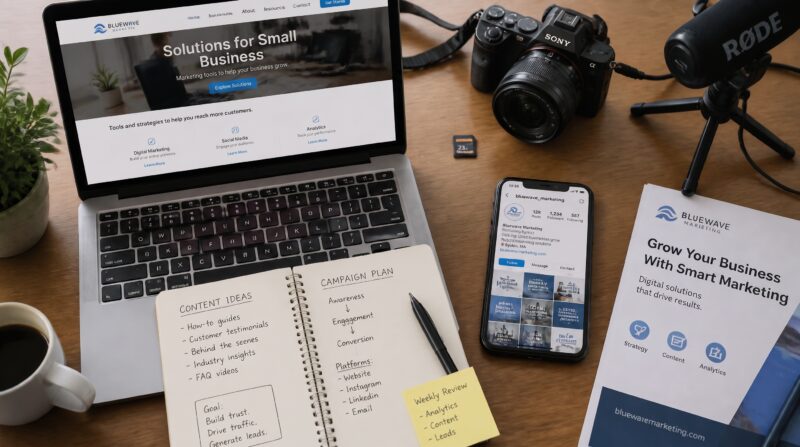
AI now assists with almost every part of digital marketing.
Does every piece of AI-generated text need a label?
No – Under EU rules, the visible disclosure requirement for businesses publishing AI-generated text concerns content intended to inform the public about matters of public interest that has not undergone proper human review or editorial control. That can include subjects such as politics, health, public safety and significant economic, scientific or cultural issues. That is very different from saying that every AI-assisted product description, plumbing article, service page, or Facebook post needs an AI label.
What if AI writes something and I edit it myself?
This area of the law is where things get interesting.
For relevant public-interest texts under EU rules, genuine human review and editorial control can remove the requirement for the business to disclose that the text was artificially generated or manipulated. That review needs to involve someone with suitable knowledge actually examining the substance.
Changing a few commas is not enough. Neither is running a spellcheck over 1,000 words of AI-generated content and declaring yourself the editor-in-chief. Proper editorial involvement means checking facts and sources, questioning what is written, changing or rejecting content where necessary and ultimately taking responsibility for what you publish.
What if I only use AI to improve my spelling and grammar?
This scenario is different again.
If you write something and use AI as an editing tool to correct grammar, spelling or presentation without substantially changing the meaning, EU guidance recognises standard editing as an assistive function.
That distinction matters.
AI writing an article that you barely inspect is not the same as AI helping you communicate your own thoughts more clearly.

When an image looks real, should we know that it isn’t?
What about AI-generated photographs and videos?
This type of media generation is where I think businesses need to apply a healthy dose of common sense, and where the law will clamp down particularly hard.
Imagine a builder generates a beautiful photograph of an extension and puts it in the company portfolio. Visitors could reasonably assume that the builder constructed it. Perhaps a care company fills its website with photorealistic AI carers and residents. Are visitors supposed to believe these are genuine people using that service?
Deepfakes that appear authentic but are not fall within the EU disclosure rules. However, even where those rules do not apply, there is a much simpler marketing question to ask:
Are we allowing customers to believe they are looking at evidence of something real when it isn’t?
There is a world of difference between illustration and fabrication. An AI-generated conceptual image for a blog post is not the same as inventing a project and presenting it as your own work.

Human knowledge and experience remain at the heart of useful content.
Does AI-assisted content still count as authentic content?
At Video & Web, we think AI is a fantastic tool. We use it and encourage businesses to explore what it can do. At the same time, we have always advocated producing authentic content wherever possible.
Your expertise and experience provide the little nuggets of information that customers remember and keep coming back for. AI can help with the words, but it cannot replace the years that gave you something worthwhile to say.

AI can lighten the workload, but professional judgement still matters.
I have heard of solicitors using AI to lighten the workload when preparing complex legal documents, drawing on established wording and previous examples to draft new documents. That is a long way from asking a chatbot to write a Facebook post, but the principle is much the same. AI can help with the time-consuming groundwork, while the solicitor brings the legal knowledge, experience and professional judgement needed to review, adapt and approve the finished document. The technology makes the process faster. It does not suddenly make the chatbot a solicitor.

Sometimes a useful article starts with a good old-fashioned rant.
I might arrive at the office one morning and have a rant about whether background video should automatically play on websites. AI can help organise that rant, question my assumptions, research the subject, tidy my grammar and turn it into a structured article in a fraction of the time it would take me to write from scratch. It can also help with the research I would normally do online to substantiate my article.
It is still my thought, my opinion and my experience.
Ask AI to write a generic article about website video, and it can produce one in seconds. Ask somebody who has spent years producing videos and building websites what actually happens when the two collide, and you start uncovering the useful details.
The same applies everywhere. Builders, accountants, manufacturers, consultants and tradespeople accumulate knowledge by doing their jobs. Those small insights make genuinely useful content. AI should help you communicate that expertise, not manufacture expertise you do not have.
Will AI transparency erode the small-business advantage?
I don’t think so.
AI can still help a tiny team research ideas, create imagery, organise information, maintain social media and turn expertise into useful website content. One good idea can become an article, a video, FAQs and a collection of social posts. Perhaps greater transparency will make the distinction between AI assistance and AI deception more important.
Customers are unlikely to care that AI helped you organise an article. They may care considerably more if you use it to invent customers, projects, qualifications, testimonials or experience. In fact, authentic content could become more valuable as artificial content becomes easier to create. A photograph of your actual team, a video of somebody genuinely doing the job or an article containing insights gained through years of experience gives customers something AI cannot manufacture: evidence of who you really are.
Should UK businesses label AI-generated content now?
There is currently no general UK requirement to label everything created with AI, and plastering an AI warning over something because a chatbot corrected an apostrophe would achieve very little.
Instead, I think businesses should ask one simple question:
Did AI help us communicate something real, or did AI create something that somebody might mistake for reality?
That distinction gives us a sensible starting point even where no law requires a label. Regulation will continue to evolve, and platforms may introduce their own requirements. Businesses that sell into or operate within EU markets also need to consider whether EU rules apply to their particular circumstances.

AI can amplify your voice, but the ideas should still come from you.
AI Can Amplify Your Voice, But It Should Still Be Yours
AI has given smaller businesses an extraordinary opportunity to compete. Greater transparency does not need to change that. Let AI do some of the donkey work. Feed it your ideas, experience, conversations, opinions and even the occasional morning rant. Then use it to help turn those raw materials into something useful.
The businesses that benefit most from AI may not ultimately be those that generate the most content. They may be the ones that use it to share more of what they genuinely know. AI can give your business a bigger voice. Just make sure it still has something of yours to say.
This article provides general information about AI and marketing and does not constitute legal advice.
Further Reading:
Why Sounding Human Again May Be the Future of SEO
Need help turning this advice into action?
If you are reviewing your website, marketing or online visibility, we can help you work out what to improve first.
Related articles
 Content
How to Explain Complicated Services Simply
If it takes ten minutes to explain what your business does, you may have already lost the customer. Just because you know your profession…
Read article
Content
How to Explain Complicated Services Simply
If it takes ten minutes to explain what your business does, you may have already lost the customer. Just because you know your profession…
Read article
 Content
Where to get images to use on your website
Are you looking for high-quality images to use as featured images for your blog posts? Here are some of the best websites where you…
Read article
Content
Where to get images to use on your website
Are you looking for high-quality images to use as featured images for your blog posts? Here are some of the best websites where you…
Read article
 Content
Why the Same Message Needs to Be Told in Different Ways
There is a quiet myth in business that repeating yourself looks unprofessional. We explore why the same message needs to be told in different…
Read article
Content
Why the Same Message Needs to Be Told in Different Ways
There is a quiet myth in business that repeating yourself looks unprofessional. We explore why the same message needs to be told in different…
Read article
 VideoandWeb.com