The Perfect One-Page Website – The Key to Simplicity and Speed

The perfect one-Page website – The key to simplicity and speed. Everyone knows that websites need to be fast, simple, and mobile-friendly. The modern user has limited attention and will abandon your website if it doesn’t load quickly on their mobile device or if it’s too complicated to navigate.
With the increasing usage of voice search and AI bots such as Siri, Alexa, Google Assistant, etc., the way users interact with the digital world is changing rapidly. If you are building a new website for your business or updating an existing site, these principles will help you create a one-page design that is fast and easy to use.
This type of website is also referred to as a microsite or single-page site because all its content is displayed on a single page. This article will explain why this type of website design is advantageous in today’s digital environment and how you can create a perfect one-page website for your business using these six principles.
The Importance of Simplicity and Speed in Web Design
A website must perform on all fronts to be successful. It has to look great, be intuitive to use, and load quickly. In addition, the user experience must be outstanding across all devices – desktop, laptop, tablet, and mobile.
The website must also be easy to maintain, which means it should be simple to update. In the digital world, attention spans are short, and competition is high. If a user finds your website too complicated it takes too long to load, she will go elsewhere. Users have become accustomed to simplicity and speed from the apps they use daily, and now they expect the same from websites.
Research shows that even a one-second delay in page load time can reduce conversions by 7%. And 78% of mobile users will abandon a site if it takes longer than 3 seconds to load!
One Page Websites Are Highly Responsive
A one-page website is responsive by definition. This means it automatically responds to the device it is being displayed on, adjusting both its content and appearance to create the best user experience.

One-Page Websites are perfect for mobile browsing
In a one-page website, all the different sections of content – images, text, videos, etc. – are displayed on one page. In addition, this single page adjusts its size and other attributes, such as font size and colour, to fit any screen size. This responsive behaviour makes one-page websites a perfect fit for today’s ever-growing number of devices and screen sizes, including desktops, laptops, tablets, mobile phones, smartwatches, and other wearable devices. Moreover, a one-page website will look great on any device and have a simple, intuitive user experience.
One-Page Websites are Good for SEO
If you’re wondering about a one-page website’s impact on SEO, don’t worry! One-page websites are perfectly optimized for search engine ranking. In fact, this type of website is a tried-and-true SEO strategy that has been in use for many years.
One-page websites are great for SEO because they have a single URL that contains all your content. This URL can be optimized using the best SEO practices, such as relevant keywords, headings, meta descriptions, and internal linking between different page sections. One-page websites are also easily optimized for mobile devices, a significant SEO challenge.

With a one-page website, you can create separate, mobile-friendly URLs for each page section. This is often referred to as slicing your website.
Single-Page Websites are Easy to Maintain and Update
One-page websites are great for easy maintenance and content updates. This is a significant advantage over multi-page websites, where each page must be updated separately.
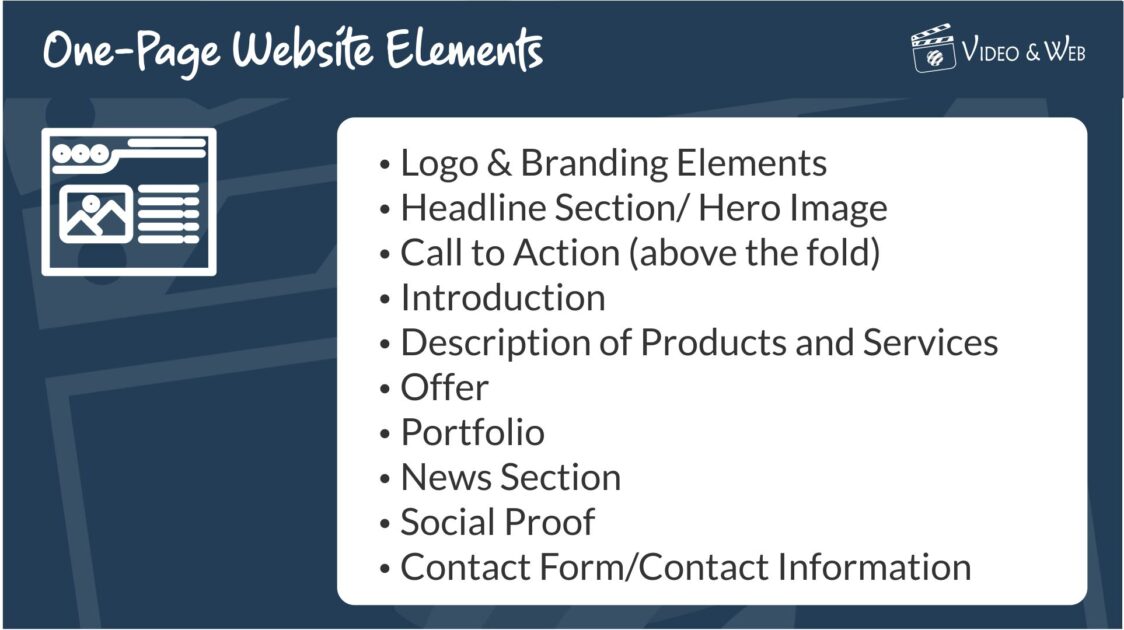
A logical series of page elements create the perfect one-page website
Many businesses have a large amount of content to update on their website, such as products, services, events, and press releases. Having to update multiple pages for each of these types of content can be a time-consuming process.
One-page websites allow you to change the page’s entire content with just one click. This makes them ideal for businesses with a lot of content that needs regular updating.
Once you’ve created your one-page website, you can update it whenever and as often as you want with no extra effort. There is no need to create new pages and link them to your current site. Instead, you can just add new content to your existing one-page website.
Single-page websites are more user-friendly
One-page websites are designed with the user experience in mind. Therefore, they are focused on simplicity and providing an excellent experience for the digital user with all the vital elements on one page.
One-page websites are designed for digital devices, which is why they provide the entire experience at a single glance and don’t require the user to click through multiple pages to get the content they require.
You can invite the user to take action, such as downloading an e-book, signing up for a newsletter, sharing content, or making a purchase.
Conclusion
A one-page website is wise for businesses with a lot of content to share, especially businesses that want to engage their users and encourage interaction. With a one-page website, you can provide the whole experience of your brand and product with everything on one page.
Single-page websites are easy to maintain and update and great for SEO. In short, a one-page website is a perfect solution for today’s digital environment.
Further Reading:
Making the perfect landing page
Which Video Should You Use for Your Home Page?
Need help turning this advice into action?
If you are reviewing your website, marketing or online visibility, we can help you work out what to improve first.
Related articles
 SEO
Designing a Website with SEO in Mind
Designing a Website with SEO in Mind walks you through the steps you need to creae a website that serves people and search engines…
Read article
SEO
Designing a Website with SEO in Mind
Designing a Website with SEO in Mind walks you through the steps you need to creae a website that serves people and search engines…
Read article
 Branding
Designing Websites Around Colour
In this blog post, we'll explore how harnessing the power of colour in web design can elevate mood, increase engagement, and ultimately drive conversions.
Read article
Branding
Designing Websites Around Colour
In this blog post, we'll explore how harnessing the power of colour in web design can elevate mood, increase engagement, and ultimately drive conversions.
Read article
 SEO
How To Improve Your Website’s SEO By Optimising Page Speed
In this blog post, we look at why faster is better when optimising page speed for SEO and how improving load times can greatly…
Read article
SEO
How To Improve Your Website’s SEO By Optimising Page Speed
In this blog post, we look at why faster is better when optimising page speed for SEO and how improving load times can greatly…
Read article
 VideoandWeb.com