
How to Use AI to Create Content Without Losing Your Voice

AI gives you a revolutionary business advantage.
AI is a revolutionary tool. That might sound like the opening line to a tech sales pitch, but it’s true. If you run a business with a website and care a little about getting found on Google, then you’re already in a race. And the thing about AI is that it gives you a serious advantage in that race if you use it right. This article shows you how to use AI to create content without losing your voice.
Let’s not sugar-coat it. Website content makes or breaks your SEO. It’s not about stuffing pages full of keywords anymore. It’s about offering fresh, useful content that tells search engines and people you’re active, insightful and trustworthy. Your website shouldn’t be a digital brochure gathering dust. It’s an always-on media channel where your business tells its story, showcases its expertise and builds trust with every new visitor.
The more relevant content you publish, the greater your digital footprint becomes. Think of it as claiming more land in the bustling cityscape of the internet. You want to own as many acres as possible. Every blog, every guide, and every page adds another square metre to your territory. And that territory is what drives traffic and clicks.
That said, I know content isn’t everyone’s favourite topic. When I talk to clients about writing blogs or updating their websites, it sometimes feels like I’ve handed out homework. I get it. I enjoy writing now, but it wasn’t always that way. It’s a skill I’ve honed over the years of running my web business. If writing fills you with dread, don’t despair. There’s help at hand. AI might be just the ticket. Used well, it can take your ideas and speak in your voice. Here’s how.

Increase your digital footprint with more content.
AI is Like Having an Eager Assistant Who Never Sleeps
Imagine a student who turns up early, stays late and always wants to help. That’s AI in a nutshell. It doesn’t get tired or distracted; it just waits for your instructions before getting to work. Ask it to write a blog on any subject and give it a style, tone, and voice, and it will get to work. Do you want it formal and informative? Done. Do you prefer casual and quirky? No problem. It can create summaries, social posts, product descriptions and newsletters in minutes. But the best results come when you give it the right ingredients.
Your Voice is the Secret Sauce
AI writes fast. But it doesn’t know you. It can’t tell your stories or share your client wins. It doesn’t understand the little nuances and observations that make your content and expertise uniquely yours. That’s why you need to bring the insight. The blog becomes powerful when you feed it your own experiences. Case studies, client questions, lightbulb moments, even rants — these are the gold dust. AI turns that raw material into something polished, readable and search-engine friendly.
Remember, people read blogs to learn something or to connect. They want to hear from an actual human with authentic opinions. That’s what keeps them coming back. That’s what makes them trust you. And that’s what nudges them closer to buying from you. So, let AI shape your blog by all means, but make sure your personality shines through.

Give AI some substance, and you will reap the rewards.
How to Tell AI What to Do (And Get What You Want)
Using AI well is all about prompts. A prompt is simply an instruction. The more precise and detailed your prompt, the better the output.
You might say:
Write a 500-word blog post about choosing the right signage for a small business website. Use British spelling, avoid passive voice, and make it personal and friendly in tone. Include a bullet list and end with a summary.
Now, that’s a good prompt. It gives the AI structure, tone, and purpose. Since you’ve already done the thinking, the tool can run with it.
Once you’ve found a style you like, you don’t need to reinvent the wheel every time. Save your best prompts, tweak them slightly for different topics, and reuse them across your blog categories or campaigns. Consider your prompts like recipes—adjust the seasoning but keep the structure.
Example commands that work well.
- No passive speech
- Use British spelling and phrasing
- Use varied, non-repetitive vocabulary
- Make it personal and conversational
- Avoid starting multiple sentences the same way
- Include one numbered list and one bullet list at most
- Finish with a summary paragraph or checklist
These prompts create consistency in your content. Over time, they help you develop a recognisable voice online, even if AI is doing most of the heavy lifting behind the scenes.
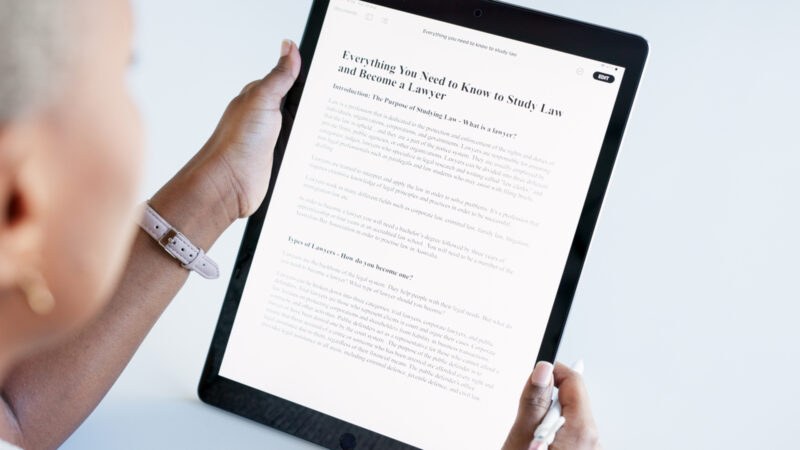
Use something you’ve already written to create an AI blueprint.
Create a Blueprint from Something You’ve Already Written
Use it as a blueprint if you’ve already written a blog or article that captures your voice perfectly. Copy and paste the text into your AI tool and say:
Use this as a writing style guide. I want future blogs to match this tone and format.
AI can analyse your sentence length, structure, rhythm and vocabulary. It learns from your punctuation, your paragraph breaks, and even your use of humour or rhetorical questions. This method is one of the fastest ways to train your AI assistant to sound more like you.
You can go even further. Ask it to summarise what it notices about your writing style, then ask it to apply that same style to new content. Before long, your AI-generated content will feel seamless alongside your human-written work.
This technique is also brilliant if you’re trying to scale up. Let’s say you’ve written five substantial articles already. Feed them into AI and ask for five more that match the quality and style. You’ve just doubled your content output without breaking a sweat.
Give AI some Substance
So, you’ve found your style and voice, now you need to include your ideas and expertise. AI will write a perfectly good blog if you give it a subject to write about. However, delivering generic content to your customers won’t keep them coming back for more. As I mentioned earlier, the more you can put into the recipe, the better the product that pops out. So before you hit the go button, give AI some information to include in your blog. It doesn’t need to be extensive or written in order; write it like you would record ideas on a notepad. Anecdotes, hints, tips, and insights are all good. Just throw it all in there!

There is no substitute for authentic content.
Actual Content That Builds Real Trust
Your blog can do so much more than fill space. Done well, it builds trust with every post and shows potential customers that you know your stuff. Blogs help them understand your values and your approach. Your words create small but powerful moments of connection.
So don’t hand the whole job to AI. Use it to amplify your ideas, not replace them. Share the stories only you can tell. Be honest, specific. and generous with your knowledge. That kind of content doesn’t just get read — it gets remembered.
Final Thoughts: AI is a Tool, Not a Shortcut
Used wisely, AI will help you:
- Create content faster and more consistently
- Maintain a clear and recognisable voice
- Get more relevant pages onto your website
- Reach more people with the right keywords
- Turn rough ideas into polished posts
- Train an AI assistant to match your writing style
- Save time without sacrificing quality
- Build trust and authority with your audience
- Repurpose prompts and formulas to scale up
- Keep your website fresh, active and Google-friendly
That’s a lot of impact for one tool. But the real magic happens when you bring your ideas to the table. AI can’t know what you know — but it can help you share it with the world.
Further Reading:
The Anatomy of a Perfect Blog Post
What is AI RankBrain and How Does it Affect Your Search Results?
Need help turning this advice into action?
If you are reviewing your website, marketing or online visibility, we can help you work out what to improve first.
Book a marketing reviewRelated articles
 SEO
Why Sounding Human Again May Be the Future of SEO
Why sounding human again may be the future of SEO. Discover why authentic content, Geo Marketing, and real expertise matter more than ever in…
Read article
SEO
Why Sounding Human Again May Be the Future of SEO
Why sounding human again may be the future of SEO. Discover why authentic content, Geo Marketing, and real expertise matter more than ever in…
Read article
 Content
Why the Same Message Needs to Be Told in Different Ways
There is a quiet myth in business that repeating yourself looks unprofessional. We explore why the same message needs to be told in different…
Read article
Content
Why the Same Message Needs to Be Told in Different Ways
There is a quiet myth in business that repeating yourself looks unprofessional. We explore why the same message needs to be told in different…
Read article
 SEO
How to Get Your Website to the Front of the Crowd
Creating a website today without SEO, social media, or any marketing at all is a bit like standing at the back of the O2…
Read article
SEO
How to Get Your Website to the Front of the Crowd
Creating a website today without SEO, social media, or any marketing at all is a bit like standing at the back of the O2…
Read article
 VideoandWeb.com